Graphic Courtesy/WV Schooling Division
-

-
Graphic Courtesy/WV Schooling Division
-

-
Graphic Courtesy/WV Schooling Division
-

-
MEETING West Virginia Board of Schooling Chairman Paul Hardesty, middle, informed fellow board members on Wednesday that disparities in self-discipline amongst college students had been unacceptable. —Steven Allen Adams
CHARLESTON — The West Virginia Board of Schooling has obtained a extra detailed report on scholar self-discipline in public colleges, with state training officers calling the numbers unacceptable.
The state board convened Wednesday for its month-to-month assembly on the places of work of the Division of Schooling on the grounds of the State Capitol Complicated in Charleston.
Board members heard a report on West Virginia Colleges Self-discipline Knowledge introduced by Drew McClanahan, Director of Management Growth and Assist for the Division of Schooling, and Georgia Hughes-Webb, Director of Knowledge and evaluation within the ministry.
The up to date report examines faculty self-discipline knowledge from the 2022 faculty yr, together with the overall variety of disciplinary incidents, in-school and out-of-school suspensions, variety of college students concerned and main demographic subgroups.
In response to the report, there have been 169,963 whole disciplinary incidents within the 2022 faculty yr, with 51,432 college students referred for self-discipline. There have been 66,904 suspensions, with 28,702 college students suspended, lots of whom had been repeat offenders – one in 10 college students. Suspensions account for 177,777.75 misplaced tutorial days, with a median of 6.19 misplaced days per suspended scholar .

Graphic Courtesy/WV Schooling Division
“It is fairly important,” Hughes-Webb stated. “When you had been referred for a disciplinary incident final yr, there is a good probability you may get a suspension.”
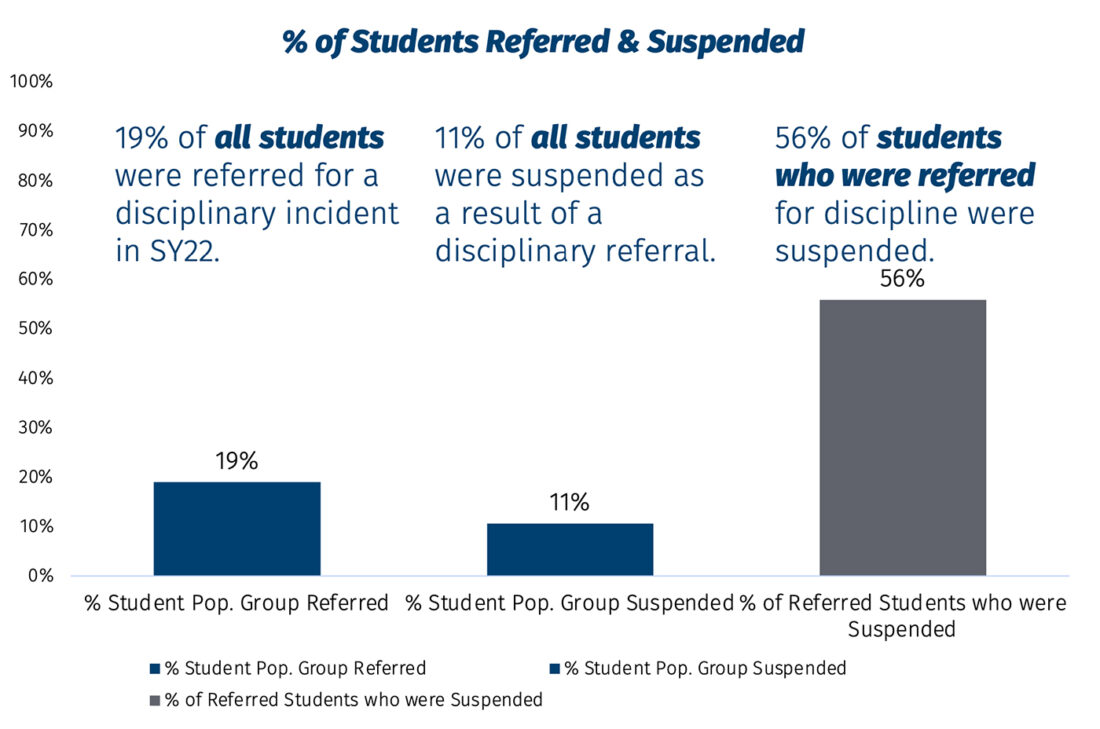
Trying on the knowledge, 19% of all college students within the 2022 faculty yr had been referred for a disciplinary incident, with 11% of all college students suspended because of this. Of the variety of college students referred for self-discipline, 56% had been suspended.
“We now have the punishment facet, however that is the one factor now we have, and who suffered due to that? Our youngsters,” stated State Board of Schooling Chairman Paul Hardesty.
Damaged down by race, 31% of scholars referred for disciplinary incidents had been black whereas black college students made up 4% of the scholar inhabitants in 2022. Multiracial college students made up 24% of referrals, 18% had been white, 17% had been Hispanic/Latino , and 10% belonged to different racial minorities. Of those that had been suspended, 20% had been black, and the share of referred black college students who had been suspended was 64%.
Black college students accounted for 8% of all suspended college students, with 10% of black college students concerned in incidents leading to suspensions, and 11% of all tutorial days misplaced resulting from suspensions got here from black college students. Of those suspended black college students, 50% had been suspended in class whereas 50% had been suspended out of faculty. Economically deprived college students and homestay college students had been additionally extra prone to be positioned on suspension from faculty.

MEETING West Virginia Board of Schooling Chairman Paul Hardesty, middle, informed fellow board members on Wednesday that disparities in self-discipline amongst college students had been unacceptable. –Steven Allen Adams
College students from economically deprived households had been additionally the toughest hit by disciplinary dismissals and suspensions, with 23% of economically deprived college students being expelled for disciplinary motion and 14% suspended. Of the overall variety of suspended college students, economically deprived college students accounted for 60%.
College students positioned in foster care represented 34% of the overall scholar inhabitants referred for self-discipline and 24% of suspended college students. Of the variety of college students suspended, foster youngsters accounted for 73 p.c. College students with disabilities 23% of the overall scholar inhabitants referred for self-discipline, 15% of the suspended scholar inhabitants and 65% of the referred college students who’ve been suspended. Homeless college students accounted for 29% of referrals and 17% of suspensions, or 60% of referred college students who had been suspended.
Hardesty referred to as on all branches of presidency to return collectively — together with the Legislative Meeting, Gov. Jim Justice, the Division of Well being and Human Assets — in addition to educators, group leaders and the religion group to assist resolve the issue of disciplinary disparity of the State.
“Women and gents, this recommendation can’t clear up this downside alone,” Hardesty stated. “We put our playing cards on the desk right here in the present day. We now have an issue of epic proportions. No marvel we’re within the place that we’re on competence… We’re failing our children. It have to be an entire overhaul. We now have to do one thing completely different.
The Board of Schooling requested the division final December to develop the scope and depth of a report launched in July on statewide knowledge on faculty disciplinary motion required by the passage of the Senate Invoice 723 in 2020 after some council members and group advocates complained the report didn’t discover the info.
SB 723 required the Division of Schooling to overview statewide knowledge on faculty disciplinary actions and develop a plan to scale back the variety of disciplinary actions. The division is required to submit a report back to the Legislative Oversight Fee on Schooling Accountability each two years.
One of many board members who was sad with final summer season’s report, retired educator Debra Sullivan, had just one phrase to explain the in-depth new report introduced Wednesday.
“Wow.”
Sullivan stated the brand new report is rather more detailed and can current state/native training officers and the general public with a roadmap for locating methods to scale back the variety of disciplinary incidents, establish colleges that had been disciplining primarily based on race or socioeconomic situations and assist guarantee these college students obtain the assistance they should succeed.
“It is thorough, it is complete…and what you have achieved has given us an correct image of the state of our colleges when it comes to self-discipline,” Sullivan stated. “Earlier than, we simply form of had a sense. However due to knowledge, we will drive options… it is a possibility for us to alter the dynamic. Earlier than we had an outline of the state, however now we all know the street.
McClanahan stated the division will start implementing a plan this summer season to reverse the disciplinary numbers. Emphasis will probably be on in-person and digital trainings with lecturers and directors, emphasizing being much less bossy, working with native communities, analyzing socio-emotional helps, classroom administration and altering faculty tradition.
“Our colleges must be secure and conducive to studying, however we additionally want to grasp that we will impression scholar habits and the continued behaviors that we could also be seeing,” McClanahan stated.
To enhance the info, a faculty self-discipline dashboard will probably be designed. The information will enable officers to arrange disciplinary knowledge flags to seek out colleges with issues. The division will even suggest coverage adjustments, together with ending zero-tolerance self-discipline insurance policies, strengthening the implementation of due course of, reviewing the 4 ranges of self-discipline, and inspiring options to suspensions and excluding.
Hardesty praised Reverend Matthew Watts, a pastor on the predominantly Charleston Black West Aspect and chief of the Tuesday Morning Group, a corporation targeted on financial and social justice points. Watts and the Tuesday Morning Group have raised the problem of faculty self-discipline disparities for years.
“The Tuesday Morning Group commends State Board Chairman Paul Hardesty, State Board members, and Superintendent David Roach for compiling and publishing the detailed evaluation of West Virginia State Colleges Self-discipline Knowledge “Watts stated in a press release Wednesday afternoon. “After greater than eight years of advocacy, the TMG is inspired to see that there’s lastly a state faculty board and a state superintendent who’re prepared to acknowledge and acknowledge the seriousness and complexity of extreme faculty self-discipline. college students and suspensions.”
Watts recommended the state Division and Board of Schooling for presenting an intensive report and proposals. He additional referred to as for a statewide summit on faculty self-discipline and referred to as for a particular session of the Legislative Meeting to allocate funds for applications geared toward addressing the problems of disparities and expertise in low-income communities and minority communities within the state.
It’s TMG’s hope that the not too long ago launched knowledge on West Virginia faculty self-discipline will function a clarion name to seize the eye and engagement of all stakeholders,” Watts stated. “Tackling faculty self-discipline is a problem that requires a worldwide response.”
(Adams will be contacted at sadams@newsandsentinel.com)